Staring at Faulty Films

Movie reviews by Jason Edwards

Three movies have hit theaters this week, all with similar titles and themes. Has Hollywood become nothing more than an incestuous cesspool of ceaseless drivel, devolving ideas back to a single primordial ooze of consciousness, or is this just coincidence? Crackpot conspiracy theorists and elite critics, at least, can agree that this bumper-crop of sameness is nothing to be trifled with. Unless you eat your trifle with a fork and a knife!

First up is a movie called The Fault in Our Stars, about a young girl battling a terrible oxygen addiction. She walks around carrying a can of the stuff with her at all times, and is meanwhile wooed by a handsome, tall man who’s literally half of twice her age. She’s conflicted, however, because she read on Slate.com that people who read young adult novels should be ashamed of themselves, and her suitor reminds her of her stint as a pregnant high-schooler who’s senior project was to overthrow a corrupt government via virtual-reality dreams. Alas, terminally illness ensues, Mtv style.

Next is The Fault in our Stairs, a fictional-documentary about blind paraplegics fighting for better handicapable ramps to be installed next to government building steps. Look for the director’s signature “slow pain“ camera shots, a play on the word “pan” and, by coincidence, always featuring one young girl playing a boy dressed in green, tortured, and flying. Not your average art-house flick, but not for young or old or in-between audiences either.

Finally we have It’s Fred Astaire’s Fault, a film about a man who wakes up every morning and says “Good job, brain,” thanking his mind for getting him through the night unattended. Over time this practice creates a disassociation between the man and his brain, until the two become separate entities. Eventually the brain falls in love with the man, and tries to woo him by learning complicated 30s-style dance routines. The twist, of course, is that the man is a blind paraplegic. A hologram of Cream drummer Ginger Baker makes a guest cameo as Ginger Rogers.

Altogether these movies would make for a heck of a Red Box rental binge, although seeing them now in theaters would perhaps ruin such an orgy. Suffice it to say that if you only see one of these films, you won’t have seen the other two. That’s not tragedy in the Greek sense, unless by “Greek” you’re referring to the American Fraternity System. In that case, feel free to skip these and play beer pong. Pro-tip: ice keeps the beer cold and sometimes makes the balls bounce out. Peace.

Stories from Precinct 17: Hub-Bub, Hold the Ado

fiction by Jason Edwards

The door to the captain’s office burst open like it normally does and the captain himself emerged, holding something in one clenched fist, shouting, “God damn it, Marcus, what the hell is this?”

“That’s your stapler, captain,” I said.

“God damn it!” The captain shouted and went back into his office, slamming the door again. The hub-bub of Precinct 17 went back to hub-bubbing.

Sergeant David Marcus, detective, Seattle PD. Been on the job for about ten years now, and I have seen some shit. I’m far passed my wide-eyed phase, but not quite to my cynical phase. I’m sort of in the middle of a wild-cannon phase, and probably will be for a while.

That’s how my writer’s setting me up, anyway. Mostly he just fakes it as he goes, more worried about word choice than character development. Still, it’s not all bad. I have a captain who yells all the time, a partner from the Paleozoic era, and all the donuts I want without getting too fat. Not sure if I have an alcohol problem or not— my writer likes his tropes, but he shies away from cliche, when he can.

It was a typical Tuesday in Seattle. The sun was fighting the clouds, the office was a hub-bub of felony arrests and misdemeanor paperwork, and the Mariners were getting ready for their October vacation. Day game. On the radio. Noise lost in the hub-bub, Mariner’s losing in the 6th.

The captain’s door burst open again. Captain Chauncey DelaCourt, six three, black, about 290 I think. Second stringer on his college team, straight into the academy, honors, beat cop to dick to captain along the usual routes. Some claim it was a case of affirmative action, but he was a pretty god damn good captain, and nobody said no when we got that door of his reinforced for his birthday three years ago. On account of all the slamming.

“Marcus! Get your skinny white ass in here now!” He left the door open. A good sign.

I shrugged off torpor, clicked off the game, put on my jacket. It never sits right when I don’t have my service piece in the shoulder holster, but I’m no idiot— gun goes in the desk lock box when I’m not on the street. Safety before vanity, my writer likes to say, for no reason I can think of.

I went into the captain’s office.

“Did I tell you to shut the goddamn door, Marcus?”

I took that as my cue to shut the door.

“What the hell is this?” He was pointing at a folder.

“It’s a folder, Captain.”

“I know what it is god damn it. You think I’m some kind of idiot, Marcus? Is that what they taught you in that college of yours! That police captains are idiots?”

“Captain, I never went to college, I—”

“God damn it, Marcus! You’re a loose cannon! I got the mayor breathing down my neck, I got the newspapers dragging the one-seven through the mud, and do you want to know how many calls I’m getting from the citizens of Seattle about your god damn shenanigans?”

“Uh-”

“Three! So you listen to me, you no good twisted piece of waste of god damn dirt bag piece of filth! You take this case, and you do it by the book, you hear me! Or its your badge this time, Marcus! I’ll have your gun, I’ll have your pension, I’ll have you writing parking tickets in Renton! You hear me you piece of what I said?”

“Loud and clear captain.” I picked up the folder. Cold case, homicide from about 25 years ago. “What were the calls about?”

“God damn it Marcus, do I look like some kind of Dictaphone to you?”

“No, but-”

“One from some lady saying thanks for helping out on the Jenkins robbery, an anonymous call asking for a large with pepperoni and olives, and one from your wife, asking me if Tilda and I were still on for dinner this Friday, you-”

“What did you say?”

“I said yes you god damn piece of low-life no good son of a piece of now get the hell out of my office before my foot parks itself in your ass!”

I walked out, shutting the door behind me.

“And close the god damn door on your way out,” the captain shouted.

I walked over to my desk, sat down, flicked the game back on. Mariner’s still losing. Made me wonder if my writer even cared about the team. This is fiction, after all. Throw ’em a bone, let ’em win one maybe? God damned verisimilitude.

I perused the file. A grisly murder, a priest, hammer to the back of the head. I sighed a few times, read a few of the newspaper clippings attached. Homeless kids, a shelter, a foods program.

I stood up, walked over to my partner. Mezzoni, 59 years old, a year away from retirement. “You’re under arrest, Mezzoni. Get up.”

Mezzoni got up with a heavy defeated look on his face. “That priest was runnin’ an underage prostitution ring, ya know. He had them poor girls hooked on skag.”

“I know, Mezzoni.”

“How’d you figure it, Marcus?”

I shrugged, putting a hand on his shoulder and turning him around so I could cuff him. “There’s always a twist, and my writer wants to wrap up this writing exercise so he can go for a run.” We walked towards the holding cells while the hubibub kept on hub-bubbing. “You have the right to remain silent. When I think of something clever to interject here, my writer will come back and edit it in. You have the right to an attorney…” etc etc etc.

Thou Shalt

You ever heard that phrase, thou shalt not suffer a witch to live? I guess I have to kill a witch then. I got one living next door to me. This is a full-on, black dress, pointy hat, green skin, hook-nose-with-a-wart witch. We’re talking cauldrons, cats, the whole bit. And I have to kill her.

Not that I believe in that Jesus stuff. Not that I even own a bible. But a rule’s a rule, I guess. Not sure how I’m supposed to do it though. Do you just shoot them? Hang ’em? Drown ’em? Does it work like The Wizard of Oz, I just got to throw a bucket of water on her or something?

Thing is, it’s my own fault. I bought the place, and the real estate agent told me and everything. “Just so you know, the lady next door, Agnes, in that scary hut looking thing, she’s a witch, an actual poison-the-neighbor’s-cow type witch. She eats children. Just so you know. Sign here, here, and here.” So I only got my self to blame. Sweet deal on fourteen hundred square feet though, let me tell you.

Maybe I thought the agent was joking, but, I don’t think I can even use that as an excuse. I mean, when I moved in, I didn’t think about how there was a pasture nearby, even though I finally noticed it last week and it wasn’t even a surprise. And there was plenty of cows in it, but there’s fewer these days. And children too, running up and down the street, until one day they just stopped, like something happened.

Now it’s up to me I guess. I mean, you would think the guy who owns those cows would do it, or the parents of them kids. Get together a regular mob with the torches and the pitchforks. But they don’t. They just go about their business, shifty glances up the hill where the witch’s hut is, next to my house. And like with the pasture, I guess I knew I was buying a place sort of removed from the main thrust of things. As long as I had access to the highway. But the other day I was talking to Gena in Accounting and telling her about the place and had to admit its more or less like we live in a little village, me and the other folks ’round here.

I was looking at the shotgun I keep propped up next to the front door, just mulling over nothing, and I thought I’d maybe go for a walk, clear my head. It was one of those cold autumn nights, big fat sliver of a moon in the sky. I walked down to the village, along the dirt road and passed the usual shoppes, like the butchers and the farriers and the apothecaries. Everything lit up by candlelight, iron-bound doors shut tight. And there goes Agnes, hobbling along like she does, cackling under her breath.

And I’m thinking, what year is this? What century? Have shot guns even been invented yet? I looked at my watch, which glows in the dark and has one of them batteries that recharges itself whenever you move. It was nearly midnight. And I’m thinking, what if the crops don’t come in? Or did the crops already come in? Are we going to have rats in the grain silos? Are we going to make it through the winter?

I went back home and turned on the TV. Typical, three hundred channels, nothing to watch, so I switched it off. Sat there in the dark. A wolf howled somewhere off on the moors. A chill set in. The fire was out, just a few coals left— don’t recall having started one earlier, but I must have. Never really occured to me that I was buying a house with a fireplace in it, me, a city boy my whole life. I looked down at my plain clothes, hand-stitched, my woven shirt and rough pants. The smell of earth coming off my thick beard from spending all day in the mines. I mean at the job where I’m the assistant tech support manager. I mean the mines.

Why do witches even do it? Why do that cast spells and spoil crops and eat children? What’s their end game? Is it like, I dunno, Nintendo for them or something? Are they just mean people?

I’m looking over at my shotgun, which is basically a scythe at this point, a huge thing, looming in the corner. The clouds outside shift, the moonlight catches the edge of the scythe blade, and I guess I got some work to do.

So Much Blogging

Quickly: Had a job for twelve years, got laid off, got another job. Joggle. We make a free brain train gaming for your iPad. Go download it right now. I am the Community Manager, in charge of keeping an eye on Google Adwords, curating scholarly articles about the brain, helping with in-game and website ad copy, etc. There’s six of us. Every download we get, it looks like I’m contributing. SO GO DOWNLOAD IT. And tell your friends. Tell all of them.

But now: blogging. It all started when I started this job and was told we would be blogging. So I began writing some bits and pieces about the brain. Turns out our blog is going in a different direction. So I created a quickie Blogspot account and posted them there. It’s called The Great Brain Robbery.

Get this: one hundred page views the first weekend. I was immediately addicted. I have no idea if those page views are meaningful or not, don’t care. I started posting twice a day. Then I read that more than once a day and people won’t read it. So now I’m down to once a day.

Meanwhile, I published a book and decided to blog to support that, too. Zombie For Life is the blog that supports Still Life, With Zombie, a collection of short stories. Buy it today. But some for your friends.

And finally, there’s ‘Other,’ which was my “original” blogspot/blogger blog, back in the day when a lot of friends where blogging and I wanted to be on the same platform as them. That blog has also become a daily thing, too, a place to sort of dump my thoughts about taking the bus and working in an office and just getting over 12 years of working from home.

That’s a lot of writing. what about good old fashioned Bukkhead? Yeah, I know, I know. sad and abandoned for a while, just a repository for book reviews and the odd short story. Tell you what, NaNoWriMo is happening right now, so  maybe I can discuss that now and again. Maybe. I mean:

That’s 3476 words today.

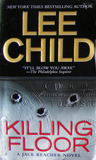
Review: Killing Floor

Killing Floor
Killing Floor by Lee Child
My rating: 3 of 5 stars

Lee Child writes in short sentences. At least he does in this novel. This is the “first” Jack Reacher novel. Why did I read it. Why not, I guess. I saw the Tom Cruise film, was told it’s not like the books at all. I accept that books and movies are different. Like baseball and football. I’m being serious. But at least the movie intrigued me. You know, another one of these super-bad-ass types. Figured I’d read the book. It was sort of what I expected.

Bad-ass type accused of murder. And then it becomes personal. Lots of violence. Justified violence and sadistic, gut-turning violence. Conspiracies. Explosions. Some sex. A “thriller,” you know, a hard-boiled genre for men like “romance” novels are for women.

But let’s get back to those short sentences. Jack Reacher spends a lot of time inside himself. He’s a loner, and he wants us to know it. He saw things as a military brat, and then as a military cop. He can handle himself in a fight. He won’t hesitate to kill a man. Honestly, I think Lee Child might have wanted to write a noir-ish detective novel, but it turned into a thriller instead.

I have no idea what the hell the title is supposed to mean. The phrase “killing floor” is used once in the novel, almost in passing. It really has nothing to do with the story. Chalk it up to some publishers pushing pulp. “Killing Floor” and a bloody handprint on the cover.

A bit slap-dash, like the novel’s style. Not necessarily a bad thing. Not sure if I’ll bother with any sequels, though.

View all my reviews

Review: Killing Floor

Killing Floor
Killing Floor by Lee Child
My rating: 3 of 5 stars

Lee Child writes in short sentences. At least he does in this novel. This is the “first” Jack Reacher novel. Why did I read it. Why not, I guess. I saw the Tom Cruise film, was told it’s not like the books at all. I accept that books and movies are different. Like baseball and football. I’m being serious. But at least the movie intrigued me. You know, another one of these super-bad-ass types. Figured I’d read the book. It was sort of what I expected.

Bad-ass type accused of murder. And then it becomes personal. Lots of violence. Justified violence and sadistic, gut-turning violence. Conspiracies. Explosions. Some sex. A “thriller,” you know, a hard-boiled genre for men like “romance” novels are for women.

But let’s get back to those short sentences. Jack Reacher spends a lot of time inside himself. He’s a loner, and he wants us to know it. He saw things as a military brat, and then as a military cop. He can handle himself in a fight. He won’t hesitate to kill a man. Honestly, I think Lee Child might have wanted to write a noir-ish detective novel, but it turned into a thriller instead.

I have no idea what the hell the title is supposed to mean. The phrase “killing floor” is used once in the novel, almost in passing. It really has nothing to do with the story. Chalk it up to some publishers pushing pulp. “The Killing Floor” and a bloody handprint on the cover.

A bit slap-dash, like the novel’s style. Not necessarily a bad thing. Not sure if I’ll bother with any sequels, though.

View all my reviews

Review: The Long Earth

The Long Earth
The Long Earth by Terry Pratchett
My rating: 2 of 5 stars

I’m a Pratchett fan, like most of the people who’ve read The Long Earth. Not so much that I’ve scoured the world for every scrap of his writing, but enough that if I see something with his name on it, I’ll pick it up. Not so much with Baxter. I wound up with a free copy of one his books on my e-reader, and I just couldn’t get into it. And since free means easy come easy go, I didn’t make it past page 10.

But I figured I’d give The Long Earth. After all, even though I can’t seem to get into Neil Gaiman either, I like what Pratchett and Gaiman did with their collaboration. So for this novel I guess everything was resting on Pratchett. And I guess it wasn’t enough.

Either that or there was some horribly deep metaphor here that I just never picked up on. I liked the concept of the ‘Long Earth’, and even liked the way the “technology” was discovered… but after that, all everything else was just spread too thin. Lobsang’s airship was too convenient. The natural steppers were just too convenient. The Gap, and the very Buddha-like meta-mind was too convenient. The terrible thing that happens to Madison at the end was really very too convenient. I was unmoved by any of it. I wasn’t sure what the plot was all about, if there was one at all. None of the characters resonated for me.

I could tell where Pratchett’s hand was writing the words, his light but skillful way with language, like Bach playing around on a clavichord. So it wasn’t all bad. But it wasn’t immersive enough. Pratchett’s characters (and yes I’m thinking of Discworld here) are usually so dynamic and interesting. But in The Long Earth: flat.

It’s tempting to “blame” Baxter for the things I didn’t like, but that’s too easy. Instead, I’m going to blame the collaborative process. Yes, I said I’d liked Good Omens, so it’s not that the collaborative process is guaranteed to fail. But this time, I think there was more cancelling out than augmentation.

View all my reviews

Review: The Bling Ring: How a Gang of Fame-Obsessed Teens Ripped Off Hollywood and Shocked the World

The Bling Ring: How a Gang of Fame-Obsessed Teens Ripped Off Hollywood and Shocked the World
The Bling Ring: How a Gang of Fame-Obsessed Teens Ripped Off Hollywood and Shocked the World by Nancy Jo Sales
My rating: 3 of 5 stars

What struck me most about the people and the incidents in The Bling Ring was alien it all was. Here’s a book that reports on a series of crimes, and contextualizes it all with some pop-sociology: discussions on fame, voyeur culture, teenage sexuality, the changing tides of fashion, and so on. None of it could I relate to. None of it. This was as familiar to me as any gossip rag or celebrity bio-pic.

But then, I’m a 41 year old middle-class white guy with a literature degree, a job, and a house in Seattle.

Nevertheless, Nancy Jo Sales has done a good job building as much of a narrative as possible out what’s really not much of a story at all. Some kids robbed some celebrities. I just don’t care—so why did I read it? Was it schadenfreude? Some kind of catharsis? Probably it was just the architect lover in me- I like seeing the structures behind the stories. Crime rings and the mafia and the complication of long, drawn-out political maneuvering. It’s all intrigue.

And since I plan on seeing Sofia Coppola’s film version of these events, I wanted the back story.

The thing of it is, though, there really isn’t much back story. Some kids robbed some celebrities, I said above, and that’s pretty much everything. So Sales’ book isn’t interesting for the intrigue, but for that alien aspect I also mentioned. I don’t feel sorry for Paris Hilton, nor am I glad that anything happened to her. Reading this was like watching a child poke a stick in an ant hill.

Interesting, though, how the kids got away with it while they did: none of the celebrities though to secure their belonging, and they didn’t even know what all they’d had that had been stolen in the first place. I’m not saying this justifies the theft. But it certainly suggests why I have no empathy. It shows how I can’t relate.

Indeed, my wife and set an alarm on our house when we leave, because we know it will make us feel better if we are robbed—if someone is so motivated as to overcome our best efforts at security, there’s larger forces in play than just random victimization.

You see, we all seek meaningfulness in things—and random kids stealing designer shoes from celebrities has no real meaning at all.

View all my reviews

Review: Talulla Rising

Talulla Rising
Talulla Rising by Glen Duncan
My rating: 4 of 5 stars

If The Last Werewolf was a novel about love as antidote to ennui, than Talulla Rising is a novel about motherhood as antidote to feminism. I’m not trying to suggest feminism is bad or wrong. Rather, I’m suggesting that the contexts which require a feminist approach can be mitigated by motherhood. In an ideal world, would there be feminism? Would people be, perforce, defined by gender at all? That’s not an easy question to answer. However, biology requires a difference between the sexes, and so, if that division results in inequality, feminism is an attempt to reassert equality. Motherhood, too, asserts the necessity of sexual difference.

Which is not to say a woman is not useful unless she gives birth. Rather, a person need not be defined by genitals until reproduction is at stake. The female werewolves—and vampires—in Duncan’s two werewolf novels are in no way the weaker sex. Their desires and capabilities are no different from men’s. Until, that is, motherhood is their main identity. This makes them vulnerable—but it also gives them the strength and perseverance to overcome any will that would otherwise thwart their desires.

The question that Duncan raises: is the motherhood desire innate, or is it also a matter of will? Talulla’s lacuna would seem to free her from the obligations of motherhood. But she chooses to overcome them, chooses motherhood. The kidnappers of Lorcan use her motherhood against her, and she chooses to use her motherhood to recover her son. And in the process, she defeats the forces that would dismantle her. Talulla uses reproduction as a weapon.

This is how Duncan is able to write a thriller, filled with sex and gore, philosophical musings, and witheringly self-indulgent self-awareness, without coming across as trite or hackneyed. Talulla Rising is a hell of a ride, but also a deep meditation on how feminism and motherhood are necessary in a world that would use a woman’s sex as a means by which to take away her free will. At its core, Talulla is a tender, uncompromising, inspiring.

View all my reviews